
What to do first
- Stay off the roof, especially when it is wet.
- Put a bucket under drips, and move belongings out of the way.
- If water is near a light fitting or the ceiling is sagging, keep clear and turn off the power to that area.
- Take photos of the stain and note when it appears. Is it every rain, or only heavy rain or wind from one direction?
If a tree is on the roof or there is major structural damage, call VICSES on 132 500. In a life-threatening emergency, call 000.
Why the stain is not the source
Water that gets through the roof runs along sarking, battens and rafters until it finds somewhere to drop. A stain in the middle of a room can start metres away, up near a ridge. That is why a leak needs tracing from the roof, and why sealing the nearest suspect often does not fix it.
The usual causes
| Source | What often points to it |
|---|---|
| Blocked gutters or valleys | Leaks in heavy rain only, leaves on the roof, water spilling over the gutter |
| Cracked or slipped tiles | Pieces on the lawn or in the gutter, visible gaps |
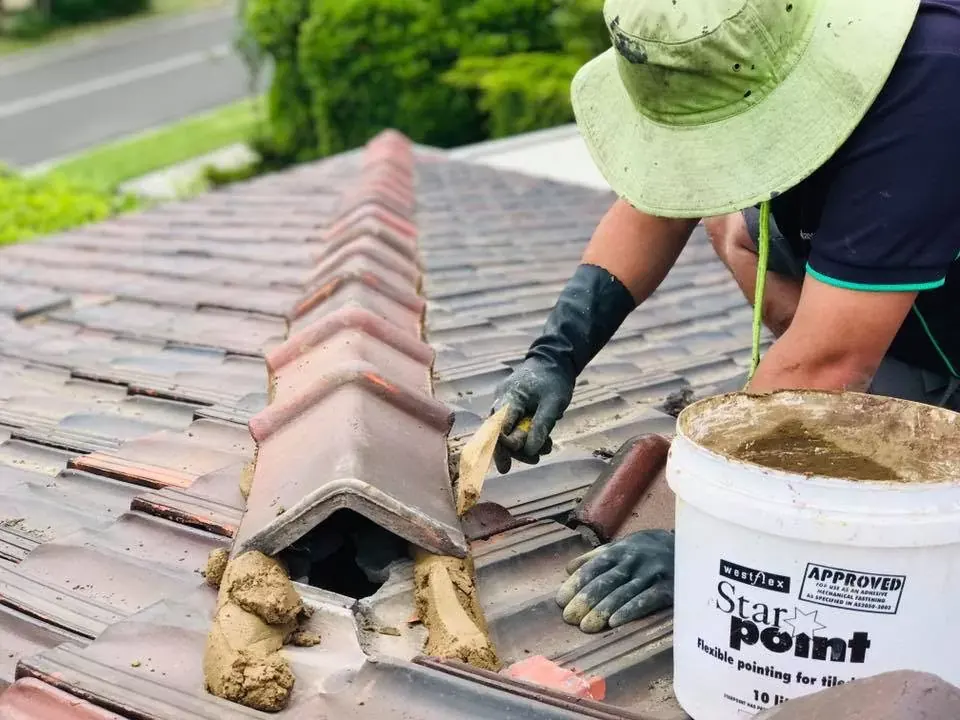
| Failed ridge pointing or bedding | Mortar on the ground, ridges out of line, stains in line with a ridge |
| Tired valley irons | Stains near where two roof planes meet, rust visible in the valley |
| Flashings at walls and chimneys | Stains on chimney breasts or against an adjoining wall |
| Box gutters | Leaks in a terrace at the parapet or party wall, overflow in heavy rain |
| Rusted metal, laps or fixings | Visible rust, lifted screws, stains that follow a sheet line |
| Skylights, vents and solar fixings | Stains close to a penetration, or that began after new work on the roof |
What is common on which houses
- Inner-city terraces: box gutters, parapets, party walls and old flashings.
- Workers’ cottages: rusted iron, lifted sheets, and where a verandah or lean-to meets the main roof.
- Tiled bungalows and post-war homes: ridge pointing, valleys and slipped tiles.
- Houses with extensions: where a newer roof joins the original.
Getting it fixed properly
A good repair starts by finding the cause. Ask the roofer what they think is causing the leak, and to show you a photograph. Be cautious if the only answer is a full restoration or a coating before anyone has gone up to look.